What is a five-gaited horse?
A five-gaited horse is exactly what it sounds like: a horse that can move in five distinct gaits instead of the usual three. Most horses worldwide have three natural gaits: walk, trot and canter. A five-gaited horse keeps those three and adds two more. For the Icelandic horse, the extras are the tölt and the flying pace. Not every Icelandic horse masters all five: those that can are called “five-gaiters,” while those without the flying pace are known as “four-gaiters.” Both are prized, it just depends on what the horse is bred and trained for.
The Five Gaits
Walk (fet)
The walk is the most natural, everyday movement for a horse — a steady four-beat gait with at least two hooves on the ground at all times. It's calm, stable and the easiest gait for a first-time rider to relax into.
Trot (brokk)
Sometimes called the diagonal gait, the trot is a two-beat movement where the horse springs from one diagonal pair of legs to the other, with a brief moment when all four hooves are off the ground. It's energetic and bouncy — fun to watch, and a good test of a rider's balance.
Canter & gallop (stökk)
The canter is a rolling three-beat gait, and when an Icelandic horse opens up into a full gallop it can really run — these little horses are far faster and stronger than their size suggests. Out in open country, a gallop across Icelandic terrain is an exhilarating thing to feel.
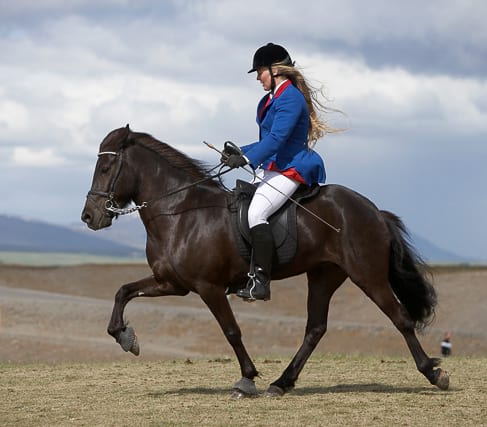
Tölt
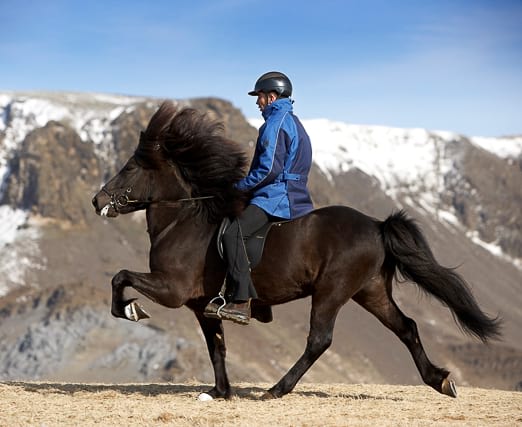
The tölt (you'll also see it written “tolt”) is the Icelandic horse's signature move, and the one riders fall in love with. It's a smooth, four-beat lateral gait in which at least one foot is always on the ground — there's no moment of suspension, and crucially, no bouncing. The result feels almost like gliding: riders famously hold a full glass of beer at a tölt without spilling a drop. A good tölt can be ridden slowly and gently or carried up to a brisk pace, and because it's so stable it's wonderfully comfortable over long distances and uneven ground. If you only try one thing on an Icelandic horse, make it the tölt.
Flying pace (skeið)
The flying pace is the showstopper — a fast, two-beat lateral gait with a moment of suspension that gives it its “flying” name. At full flight an Icelandic horse can reach around 48 km/h (30 mph) over short, straight stretches of 100–200 metres, which is why the pace is used in racing. It takes a strong, well-trained, well-bred horse to perform it, so a true five-gaiter that can fly the pace is considered the best of the best. You're most likely to see it at a horse show or a pace race rather than on a beginner ride.

Are Icelandic horses ponies?
At 132–142 cm tall, the Icelandic horse is pony-sized, so it's a fair question and a common search. But ask anyone in Iceland and the answer is immediate: these are horses, not ponies. The distinction comes down to temperament, bone structure, weight-carrying ability and a thousand years of breeding history, not just height. They comfortably carry adult riders, they have the proportions and character of a horse, and Icelanders are rather proud of the point. So while you may hear someone say “Icelandic pony,” the correct term and the one locals will gently correct you on, is the Icelandic horse.
Why the Icelandic horse is so unique
The Icelandic horse arrived with the Norse settlers over 1,000 years ago and has been bred pure ever since. Iceland banned the import of horses centuries ago, and the rule is strict: once a horse leaves the country, it can never return. That isolation has kept the breed remarkably pure and disease-free, and it's a big part of why these horses are so hardy. They come in an astonishing range of colors (more than 40 base colors and 100-plus combinations) they're famously long-lived and sure-footed, and they have an easy, people-loving temperament that makes them a joy for riders of every level.